
I Read the X Algorithm. I Think LinkedIn Is Next.
What the X algorithm release tells us about where every social feed is going, and why I’m rebuilding my content system around signals, context, and feedback loops.

X released a newer cut of its algorithm recently. Most people looked for hacks: post at this time, use this format, make more videos, avoid these words, write this many characters. That is the least interesting way to read it.
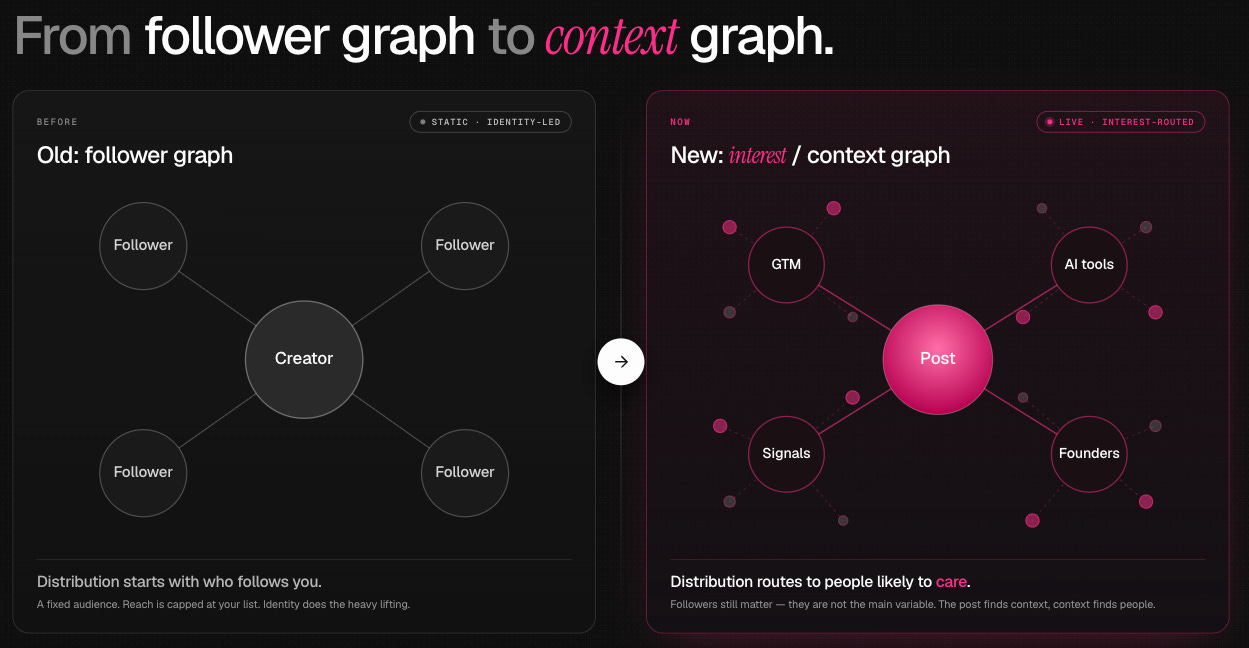
The interesting part is what the ranking signals tell you about where every social feed is going. My bet is simple: LinkedIn, X, YouTube, Substack, and most social platforms are converging on the same underlying model. They are moving away from simple follower distribution and toward context distribution.
Your follower graph still matters. But it is not the whole game anymore. The new game is whether the right people stop, read, reply, save, share, click your profile, follow, and come back.
That changes how you should think about content. It also changes how I am building my own content system.
The algorithm is not a cheat code
The mistake people make with algorithm releases is treating them like instruction manuals. They look for one variable to copy: more video, more replies, fewer posts, better hooks. All of that can matter, but none of it is the real point.
The point is that the feed is trying to predict quality actions from the right audience. It wants to know who stops, who reads, who replies, who shares, who clicks, who follows, and who comes back for more. Those actions are stronger than vanity engagement because they show actual intent.
The X ranking logic looks at positive signals like dwell, replies, reposts, shares, profile clicks, follows, link clicks, video quality views, and repeat behaviour. It also watches negative signals like not interested, mute, block, report, and posts people scroll past without dwelling.
That last one matters more than people realise. If your post gets understood in 2 seconds and forgotten in 3, that is a signal too. The feed learns that people do not need to spend time with you, and once the feed learns that, you are basically training it to ignore you.
This is not just about X
I do not think this is an X-only story. LinkedIn is clearly moving in the same direction, even if the exact weights and implementation are different. You can see it in how much distribution now comes from outside your follower base, how much topic consistency matters, and how saves, dwell, replies, and profile clicks seem to shape who gets shown again.
YouTube has been there for years. Subscriber count helps, but watch time, retention, return visits, and session behaviour are the real engine. Substack is moving there through Notes, recommendations, and network discovery.
Every platform wants the same thing: keep the right person in the right feed for longer. So the old question, “how do I get more followers?”, is not wrong. It is just incomplete.
The better question is: what topic does the platform think I own, and what actions do the right people take when I publish? That is a much harder question. It is also the one that matters now.
Why content calendars are starting to feel weak
The old playbook was built around the follower graph. Pick 3 to 5 topics, build a calendar, post consistently, rotate formats, stay visible. That playbook is not useless. It is just not enough anymore.
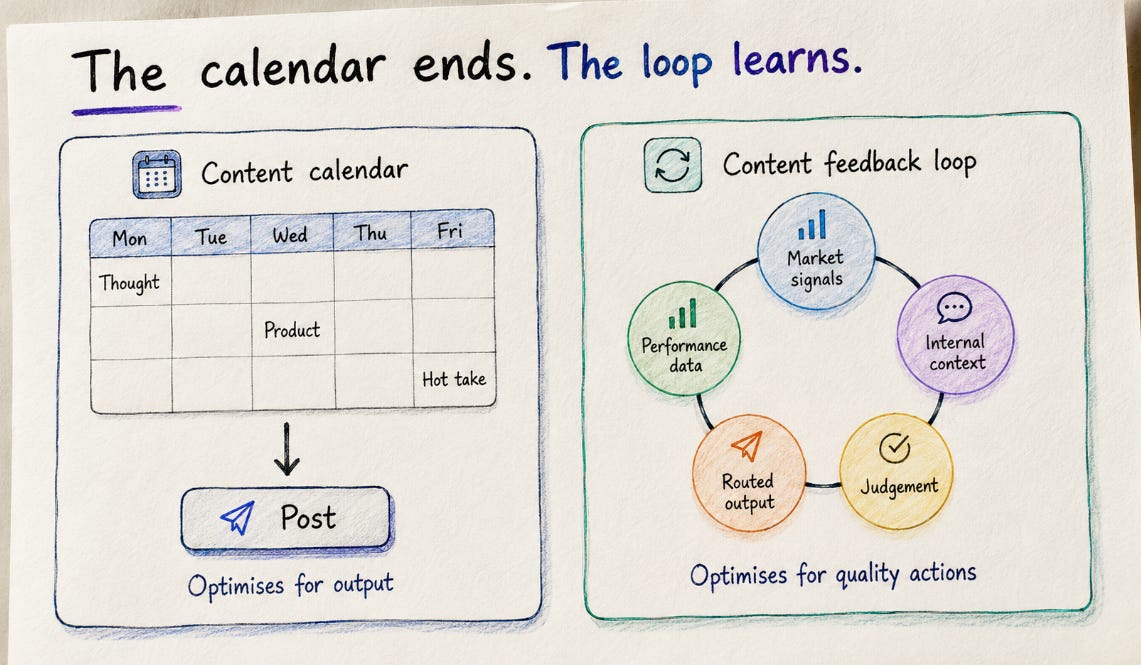
A content calendar optimises for output. It tells you what to publish on Tuesday, but it does not tell you whether anyone will dwell on it. It tells you to post a thought leadership piece, but it does not tell you whether the right buyer will click your profile after reading it. It tells you to stay consistent, but it does not tell you whether you are consistently training the feed to ignore you.
That is the part most people miss. If every platform is becoming more context-aware, then your content system needs to become more context-aware too. Not more frequent. Smarter.
What I am building instead
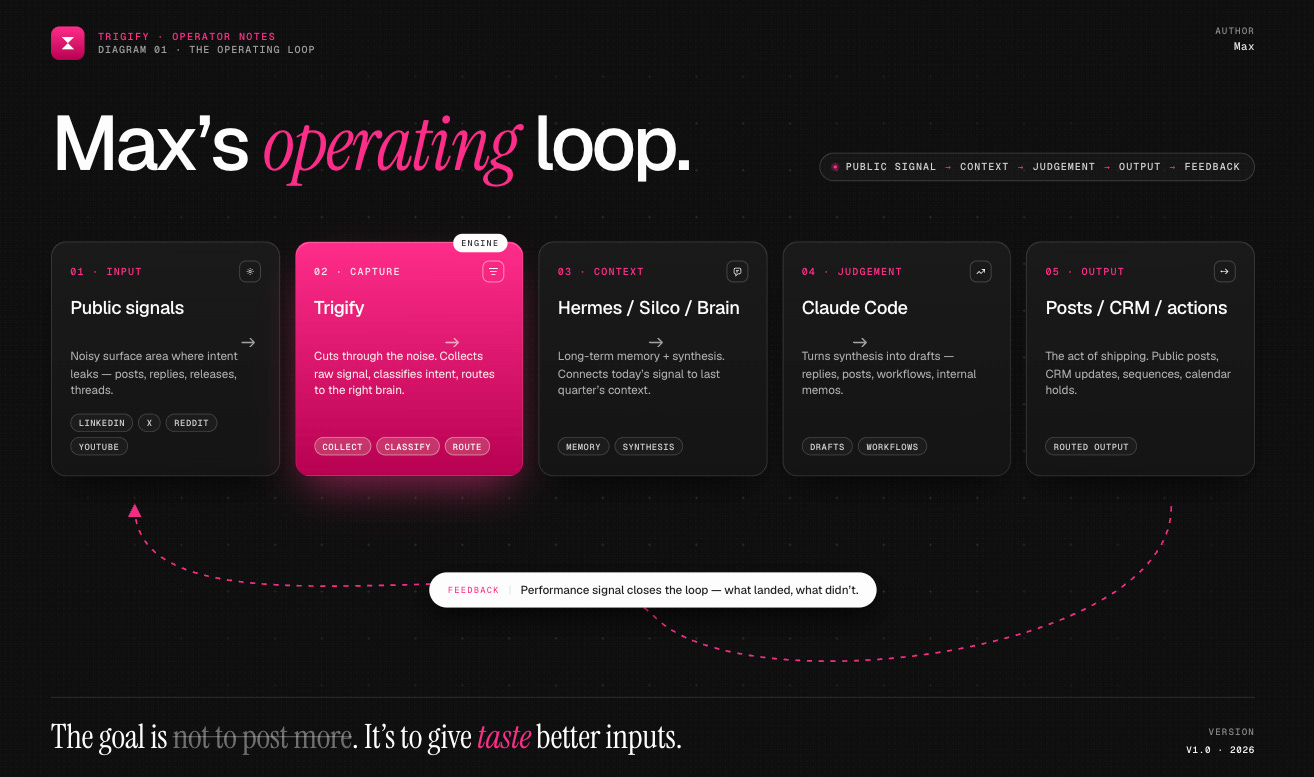
I am rebuilding my own content machine around a feedback loop, not a calendar. The flow is simple: market signal, internal context, judgement, routed output, performance feedback, then back into memory.
External signal comes first. What are people actually saying across LinkedIn, X, Reddit, YouTube, Substack, and the rest of the market? What changed this week? What language is repeating? What is getting attention? What are customers, competitors, creators, and operators exposing publicly that most teams will miss?
That is where Trigify.io sits for me. It watches the public internet and turns social activity into usable context instead of another feed to manually check. The important part is not “more data”. The important part is knowing what changed, who changed it, why it matters, and what you should do next.
Then comes internal context. What have customers told us? What did sales calls surface? What are we building? Which posts worked before? Which topics look interesting but never convert into real engagement?
That context lives in the Brain, with Hermes and Silco holding the operating memory around it. Then Claude Code helps turn the idea into something usable: a draft, a teardown, a report, a workflow, a Substack post, or a LinkedIn post.
The human part still matters most. The system can show me the market, the patterns, the language, and the evidence. But I still have to decide whether I have something worth saying. I do not want AI posting more content for me. I want AI giving me better inputs before I decide what to say.
Then the output gets measured. Did people dwell? Did they reply? Did they save it? Did they click my profile? Did it create a conversation worth following up on? That performance goes back into the system, so the next piece starts from better context. That is the loop.
The goal is not to post more
This is probably the biggest shift in how I am thinking. For years the advice was basically volume dressed up as strategy: post every day, be consistent, repurpose everything, turn every idea into 10 assets.
Some of that works. But if the feed is learning from quality actions, bad volume gets expensive. Not financially expensive. Algorithmically expensive.
Every weak post is a training signal. Every skipped post teaches the feed something. Every generic AI take that gets skimmed and ignored tells the platform your content is easy to pass over.
So no, I do not think the answer is to publish 5 times a day because the algorithm wants freshness. I think the answer is to become very hard to ignore inside a narrow topic lane.
For me that lane is pretty clear: public social signals, agent workflows, GTM context, founder-led content systems, and turning market activity into action. That is what I want the platforms to understand about me. More importantly, that is what I want the right people to associate with me.
The practical takeaway
If you are building founder-led content, I would not start with the calendar. I would start with the loop.
Ask five questions. What market signals do you actually watch? Where does that context get stored? How do you decide what is worth saying? What formats create dwell, saves, replies, and profile clicks? How does performance feed back into the next post?
Most teams cannot answer those questions. They can tell you their posting cadence, their content pillars, and their formats. But they cannot tell you how the system learns.
That is the gap. The next wave of founder-led growth will not be won by the person posting the most. It will be won by the person with the best loop between market signal, internal context, judgement, content, and action.
That is what I am trying to build. It is still messy, still early, and still changing every week. But I am convinced this is the direction.
The platforms are telling us what they reward. The question is whether your content system can hear it.